Link: Blaming Rape Culture on Social Media

Posted by Alexandra Salazar on Thursday, October 10, 2013

Thinkprogress' Tara Culp-Ressler reports on the blaming of rape culture on social media. Every media major and sociology major who reads it groans (or ought to groan) in recognition and agreement:
The takeaway from these students’ comments is that it was a very bad decision to put these things on the internet. Their statements aren’t actually condemnations of the attitudes that fuel rape culture in the first place, or expressions of horror that some women at the university have likely been subjected to these “rapebait” strategies. They’re expressions of concern that the frat brother has attached his name to something that fraternities are supposed to keep behind closed doors, something that might hurt his job prospects in the future.
Blaming social ills on modern media, technology, or progress is nothing new. No, really. It is not new. It is literally one of the oldest things that people have done.
"Times are bad. Children no longer obey their parents, and everyone is writing a book." - Marcus Tullius Cicero (106-43 BC)
While it is true that social media reflects the social climate, and may be used to promote rape culture, rape culture is older than social media. It's a part of patriarchal dominance of culture and has only found a new expression, not a revival. There was no death of rape culture to begin with. It's not new.
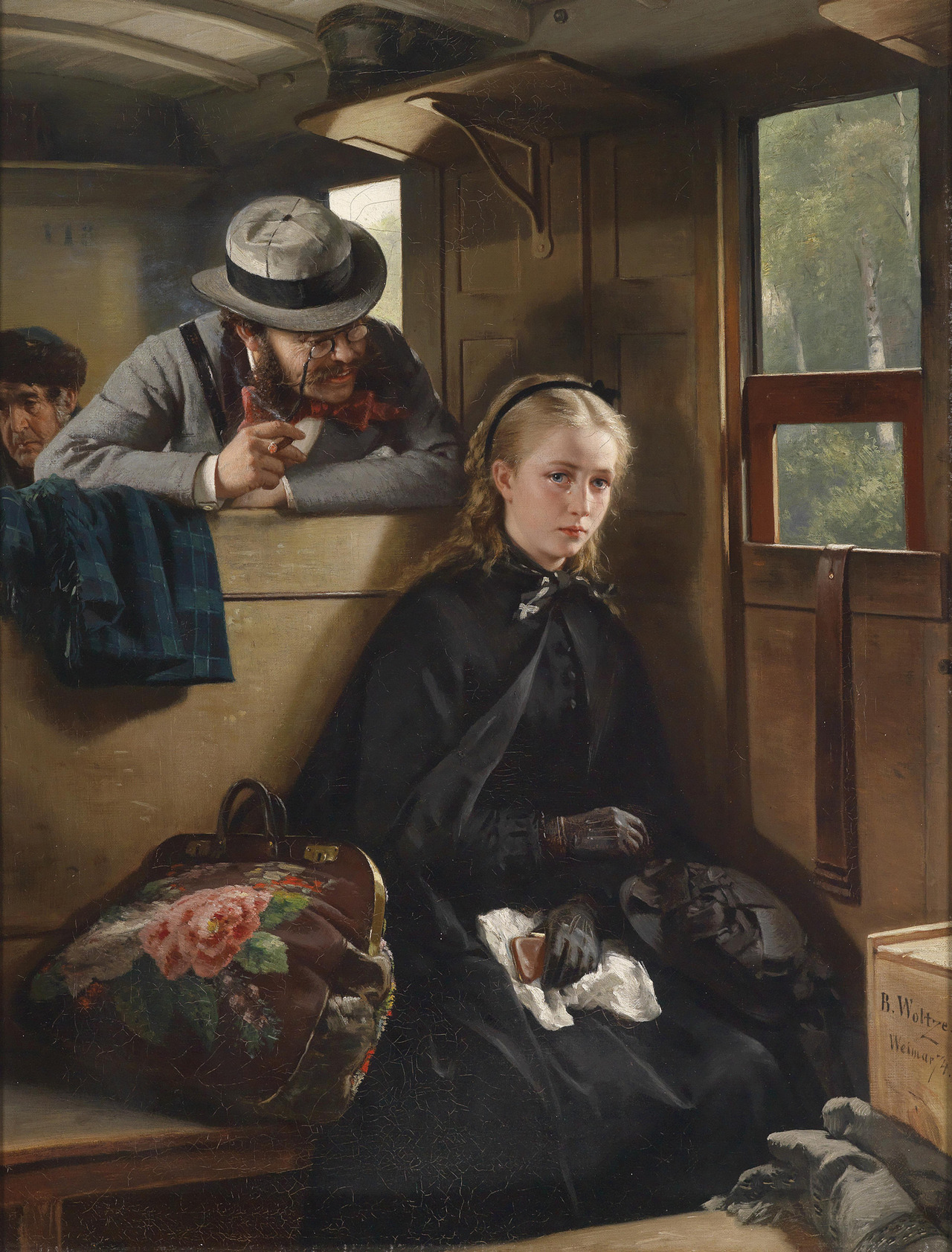
The Irritating Gentleman, Berthold Woltze, 1874. This young woman is probably in mourning, and this man still thinks she ought to give him a smile or respond to his catcall anyway.

It's been proven that blaming violence on comic books wasn't scientific or at all supported by reality. Violence predates comic books, certainly. Sexism and a culture that endorses sexual harassment are also older than our modern media.

They might even be older than Cicero.
More about → Link: Blaming Rape Culture on Social Media

Link: Demanding Representation of Black Girl Nerds in Geek Culture

Posted by Alexandra Salazar on Wednesday, October 9, 2013

When Chaka Cumberbach asks her readers to name some black female superheroes, she mentions that the nerdiest among us might forgo Storm and remember Bumblebee, Nubia, or Misty Knight. However, for anybody less comics-savvy, those names are probably unknown.

True fact about me: When I was little, I thought Storm was the coolest of the X-men and I don't redact this at all today.

She also relates her own childhood as a black female nerd, and connects the issues. It's a fact that mass media doesn't adequately represent women of color. But what is the impact of this narrative, that your heroes don't look like you, on the people growing up listening to it?
We’re given so few characters that I’ve always felt that if I wanted more, I had to be grateful for what I’d been given and put my money where my mouth is. But I’m not going to lie –- that strategy doesn’t seem to be working. I’m getting really tired of just accepting whatever scraps are thrown our way. I’m completely over struggling to find the silver lining in an obvious token black character while on the other end of the spectrum, people who have never had to think about finding racial representation in popular culture feel justified in raising hell over color blind casting in a sea of predominately diversity starved movies -– yeah, I’m looking at you, people who acted like Rue’s casting in the Hunger Games was a personal slight but interestingly enough seemed completely OK with the damn near catastrophic white washing in "Avatar: The Last Airbender."
It's a fact that watching television reduces self esteem in children for every demographic except white males. And yet, the stereotype of a 'nerd' is a white male. Is it any wonder that many 'nerdy' or 'geeky' culture artifacts are media-based, then? Is it any mystery that these media-heavy cultures are exclusionary to women of color, when it's so difficult to like what you like without feeling awful about it, unless you're the dominant cultural demographic?


More about → Link: Demanding Representation of Black Girl Nerds in Geek Culture

Nature vs. Technology: A Harmful Theme in Advertising

Posted by Alexandra Salazar on Tuesday, October 8, 2013

Example: Orange Juice.

Evan Stewart at the Society Pages notes that there's not a single person in this commercial below.

Pictured: Fresh lies are a part of a balanced breakfast.

This is weird, because nice homogeneous orange juice in plastic bottles doesn't spontaneously materialize from fresh, on-tree ripe orange fruits. That most definitely isn't the processing plant where oranges become juice, those oranges didn't pick themselves, and upper management must really be full of itself if it thinks the entire world revolves around it.

And yet, we get a positive feeling from the commercial, anyway. Why is that? Even when it erases hundreds if not thousands of workers, many of them likely migrants, below the poverty line?

And what does this have to do with this blog?

Well, this commercial is trying to tell us a story. It's trying to show us an image of pastoral harmony, uncorrupted by the hands of man. This would be a useless image to try and sell to us if it didn't mean something to our culture. The fact that we understand this image is because it's part of a larger narrative.

The narrative of nature vs. technology, of course.

This commercial implies that it is anti-technology, anti-industry, despite being a product for consumer purchase. It implies that the opposite of this green, unpopulated orchard is some kind of mad science lab, or a concrete-and-steel wasteland, or other harmful cliche of modern industrialization. It names an 'enemy' without saying a word.

Where they make the other orange juice.

However, these oranges that grew in an orchard would not be as large, as resistant to frost or parasites, or as healthy if humans hadn't used technology and scientific methods over hundreds of years of selective breeding and cultivation, and the orchard would be fallow if workers hadn't been employed to tend it, and the juice would never have been delivered if there wasn't a processing plant with machinery to squeeze the juice into bottles.

In nature vs. technology narratives, 'nature' is largely conservative, and seeks to preserve a sense of past and tradition. It is unconcerned with moving forward, only that people have survived before with the old ways in the old environment. This is problematic because there has never been a 'golden age' in human history where tradition has served us well, no one has been oppressed, and we all worked in the goodness of the earth.

This is a migrant worker. He has to feed his whole family on the output of these cows and sheep. This is not a pastoral utopia, this is a peasant who will be stepped on and ignored by his largely feudal aristocracy.

Technology is framed as a more progressive approach, and sometimes also as greedy: seeking short-term gain in spite of long-term destruction of an older system. However, while it is true that western industrial complexes are largely to blame for the damage to Earth's environment, it is also impossible to solve those problems without technology and maintain a similar quality of life. As much as Simply Orange® brand juice seems to despise modernity, I don't see it complaining about the polio vaccine.

I think a good example of this trope that everybody probably knows comes from the ubiquitous Star Wars. At the end of Return of the Jedi, small, furry aliens called Ewoks were able to defeat the futuristic and militaristic forces of the Empire, with nothing but stone-age technology. Because they were good, and the evil Empire was, well, evil, they succeeded, and everyone celebrated thereafter.

No! My futuristic robot walker's only weakness! Big logs!

Nature vs. Technology has new, and startling implications in our modern world. We cannot afford to despise the industry and technology that has been western culture's handmaiden in changing our natural environment. Anti-science and regressive politics are at an all-time high. Now is not the time to erase labor for the sake of peddling 'green' products that really are just more commercial culture in disguise. We have a real problem on our hands, and technology and science are our greatest tools in solving it.

No Ewok, or spontaneously-squeezing orange juice, is going to be able to save us now.


More about → Nature vs. Technology: A Harmful Theme in Advertising

Link: Can Social Media Save NASA?

Posted by Alexandra Salazar on Monday, October 7, 2013

Selena Larson of ReadWrite made an interesting conclusion: For NASA's 55th anniversary on October 1, it got a government shutdown and completely frozen funding. 97% of its employees, many scientists and other highly educated professionals, have been furloughed. However, while Congress only has a 10 percent approval rating, NASA is much-beloved.

Third-party efforts seek to use social media to restore at least partial funding to its operations, and science-loving folks everywhere are down to do just that. This is a case where twitter gets political in a frustrating situation where it seems like ordinary people have no power to change things.

As if millions lots of voices employees suddenly cried out in terror, and were suddenly silenced

Especially young people. As an example, Larson reports on NASA's own social media strategies to build buzz. Invoking the name of a major celebrity popular with young girls had a dramatic effect:
One big push for NASA is to find ways to reach more young people to encourage an interest in science and technology. Twitter has been a successful platform for engaging a younger audience, including megastar Justin Bieber and his almost 45 million followers. After tweeting an invitation to help the young musician take his act into space, NASA saw a huge uptick in its follower count, including many female fans whom it might have struggled to reach through traditional means.
We all have something to say about Mr. Beiber, but his name and his media carry weight and they mean something enormous to people: people that NASA needs now more than ever. There are connections between the media that we love, media that we may consider less important than the likes of our space program, and how active we are in perceiving issues. 
More about → Link: Can Social Media Save NASA?

Link: While Superheroes Conquer Media, Comic Books Battle Stigma

Posted by Alexandra Salazar on Sunday, October 6, 2013

This article by Melissa Rayworth of the Arkon Beacon Journal reports well on a very strange phenomenon: the mass-media bullies that once and still bully comics for being either too childish or too adult, too intellectual/nerdy or too uncultured, are cashing in on comic book idols. Meanwhile, comics themselves don't enjoy as much cultural uplift as the over $150 million gross of Marvel's The Avengers would suggest.

They've certainly cleaned up some, but it took way too long for Ant Man and Wasp to get a movie.

Rayworth quotes con-goers on their thoughts:
“If you tell somebody you read Captain America now, they know who you’re talking about,” said Sims, who blogs at websites including ComicsAlliance.com. “The characters’ being visible lessens the kind of stigma of reading comics, because people know those characters and have affection for them.”
But only to a point. Amanda Osman-Balzell is a married opera singer raising a toddler daughter while attending graduate school. When new friends visit her Tempe, Ariz., home, they raise eyebrows at her stash of comic books. 
“They see that we have comic books,” she said, “and they look at us like, ‘Really? You guys look so normal.’ ” 
She explains that many of today’s comic books boast intricate artwork and story lines far more complex and thought-provoking than their big-screen counterparts. But friends roll their eyes when she describes comics as “literature.”
There's no denying that comics have had a spotted past when it comes to integrity in storytelling. Any comic book fan can bemoan the ridiculousness of the Silver Age, and the un-needed darkening of beloved icons in recent decades.

And whatever this is. (Tarot/3 Kittens #74)

But is this really any worse or different than other forms of media? Surely written media has endured The Eye of Argon. Radio shows once were obligated to include advertisements in their actual fiction content (resulting in many a baffling radio drama about dish soap, for example). And is it any worse than television, with Toddlers and Tiaras?

Comics as a medium are older than television. And yet, television is now an ubiquitous part of our media culture. What's held comics back? Is it really the superheroes, when they score millions at the box office?

Or is it us?
More about → Link: While Superheroes Conquer Media, Comic Books Battle Stigma

Analysis of a Parthian Shot.

Posted by Alexandra Salazar on Saturday, October 5, 2013

Is this now going to be a short series on feedback media? OK, I guess this is now a short series on feedback media.

A few days ago, I discussed how feedback can create a dialog between consumers and content producers. Then, I discussed how feedback can create a dialog between consumers and other consumers. Now, I guess I am going to talk a little bit about manifestations of feedback-based dialog in real life, and how it's part of a bigger issue.

If anybody here's brushed up on historical or period warfare, the Parthian Shot was a tactic used by ancient Parthian (which was a middle-eastern empire) mounted archers. They would retreat, or pretend to retreat, and fire arrows behind them; chasing troops would advance into the cover fire.

Old school drive ride-by.

The shot I want to look at today didn't happen in the first century AD, but on September 25, 2013, and it happened on the internet. Tech blogger Jessica Roy left the online tech journal BetaBeat, and left behind a list of all the things she's not going to miss.

The list boils down to, ultimately, 'sexism.' But there are some interesting elements to her strongly-worded displeasure. Some of the highlights worth mentioning:
8. The notion that being the slightest bit critical makes you a “hater,” and the idea that providing any kind of coverage that isn’t a big sloppy BJ shows a lack of “journalistic integrity.”
Here, Roy comments on the reception of criticism and the nature of feedback. Note the similarity to Carolyn Petit's predicament when she dared to give a popular video game a 9/10, and tell me that there isn't a pattern. What is it about this feedback culture that frames professional critics as a threat when they do their jobs and are critical of media?
Also, all those snotty mansplainers and people who called me a “cunt” for talking about women in tech, and anyone who tries to derail honest conversation about these issues by finding minor typos or formatting errors that they can use to discredit my entire perspective so that they don’t have to reflect on their own participation in a culture that so clearly devalues women’s beliefs.
We can probably assume safely that the audience giving Roy and Petit feedback is similar: men who object to the voice of a woman (and all that nasty 'perspective') in their domain of choice. But Roy isn't just talking about her experience, she is also speaking about the media she's tried to produce: it's a stone-cold fact that only a quarter of IT jobs are held by women, and that many graduates with tech degrees find they cannot be hired to apply them. The comment contributors Roy curses for dismissing her points and coverage also are dismissing reality, not merely a matter of opinion or a difference in personal worldview. And they do it on a micro-basis: in a comment box, over a misplaced comma or a typo.

It's ludicrous to think that a copy error means that a proven fact of the tech industry and the perspective of somebody actually there, are invalid. But I guess that's why Roy left.

This is a dialog where the comment box intersects the real world, and real world decisions to stay or leave employment. It's easy to dismiss the significance of a mob of anonymous strangers, but as micro-aggressions build up over time, the feedback culture has the power to override artistic integrity, stop other consumers in their tracks, and even deny reality.
More about → Analysis of a Parthian Shot.

Are Banned Books and Bad Science Connected?

Posted by Alexandra Salazar on Friday, October 4, 2013

According to Kevin C. Pyle  author of upcoming book Bad For You, an exploration of the 'war on fun', and Scott Cunningham: Yes. And they answer it with a comic.

The 'he' being Fredric Wertham, and the answer being 'no.'

In the wake of Banned Books Week, it's easy to ride the outrage at a seemingly over-protective and offensive decision to limit access to media. The inherent wrongness in shushing up Harry Potter and locking away Catcher in the Rye seems like a no-brainer.

Is it, though? What kind of thought (or lack of thought) went into this kind of conclusion? It's easy to dismiss it as merely a regressive political agenda, or the hysteria of an over-protective backlash to popular culture. The states with the most challenged books, Pennsylvania, Illinois, Wisconsin, Texas, and California all struggle with anti-science legislation and the push for creationism in classrooms, and book bannings are part of that anti-intellectual substitute-for-science culture. Texas needs no comment; it's host to the anti-science think tank the Institute for Creation Research,. California has a 'Creation Museum.' Pennsylvania was host to the first direct challenge to a school district that included Intelligent Design as a part of curriculum. Illinois and Wisconsin are battleground states for the issue.

But why might this be true? And what does keeping Fifty Shades of Grey off the shelves have anything to do with it?

The subject of the mini-presentation is comic books specifically, and the 'scientific' conclusion written about by Fredric Wertham’s Anti-comic manuscript Seduction of the Innocent, and its later influence on the formation of the restrictive Comics Code Authority. Pyle and Cunningham explain how Wertham's failure to adhere to the scientific method produced biased results, resulting in real-life media restrictions.

Incidentally, the method that Wertham used, is exactly the same method that some think tanks use when creating material supporting anti-science or otherwise restrictive material: starting with a conclusion, and then looking for evidence to 'support' it.

The same things that threaten science education and critical thinking in the USA are the same things that cause book bannings, 'violent video games' as a talking point, and general devaluing of otherwise very important media. These things are connected, and to let comic books slip by is what lets Intelligent Design stick its un-evolving foot in the door.
More about → Are Banned Books and Bad Science Connected?