Showing posts with label media dialogs. Show all posts

Overprotective Creators and the Reverse Chilling Effect

Posted by Alexandra Salazar on Friday, August 8, 2014

There is no doubt in my mind that when Randy Queen, artist of Darkchylde, confronted the curators of the noted EscherGirls blog, he thought he had the law and authority on his side. After the blog, which famously deconstructs the terrible posing and art choices of comics, promotions, official game art, and other pop media sources, featured some of his content to rip into, he took advantage of the famously lax system of copyright protection on Tumblr to try and not only take it down but to menacingly approach with a lawsuit.
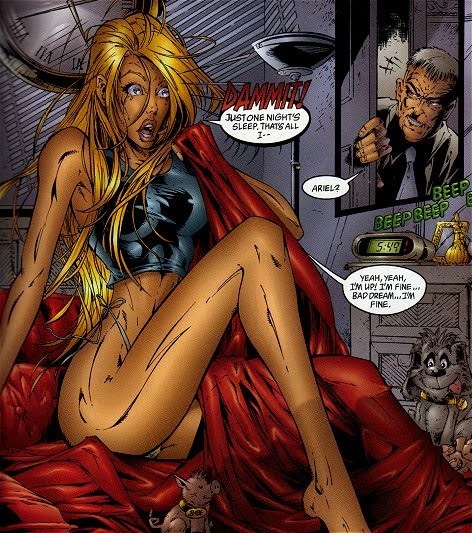
The work of a professional artist that in no way manipulates both boobs, an ass curve, a panty shot, and a supermodel leg into one panel
This, of course, is foolishness, because criticism and critique is well-known to be fair use. He promptly got torn to shreds by popehat, techdirt, and themarysue among others, and later retracted the defamation suit, and apologized publicly on his facebook page to an audience of reassuring fans and sycophants.

the DMCA and lawsuit I assume was meant to be a statement of dominance, a threat to promote the chilling effect over criticism of his artwork, backfired in a major way. Now he'll be lucky if this isn't a career killer, even with a plea to his broken marriage and the death of his late mother as his excuse.

I suppose poor mental health is a case for sympathy but I have very little patience for his sob stories if he considers parody, commentary as "harassment" as if the big bad tumblr blog actually had an impact on the viability of his livelihood, self-security or salary.

Queen's case isn't unique, however. In a recent episode of Jim Sterling's Jimquisition, Sterling details the behavior of "suicidal indie devs" that make small studio video game development look as bad as AAA establishments by picking fights when sub-quality product gets deservingly torn a new emergency exit.


Perhaps the key word here is "suicidal" in terms of their behavior. Sterling phrases it,
"While it may feel cathartic to have a video torn down from the public eye because it made fun of your shitty game, the long-term effects so far has only ever proven to be bad for the dev: who only gets negative publicity that does not translate into game sales." 
And of course, sales and the numbers are of paramount worth to the publishers that might carry games, comics, books, and other media. If you've made a fool of yourself on social media or even with a useless lawsuit, fewer publishers are going to want to risk dealing with not only your nonsense, but also the public knowledge that you're a hack and that you couldn't deal that someone said your stuff wasn't perfect.

Large studios, whole comic labels, and corporations of any sufficient size largely don't care if somebody doesn't like their products. They engineer products such that even if some people protest, their media is formulated to be as trivial, samey, and "safe" as possible. There's even books about how to do this. No matter the backlash at Disney for, say, the laziness of re-using their designs for main characters in a major animated film, the amount of money and esteem they lose is minimal, droplets of consumer tears in a desert of blistering corporate indifference.

But individual artists, small studios? In their quest to swagger and never suffer impactful criticism, to enjoy product safety just like the big guys, they just prove how much they are the little guy by waving the legal notices and the social media threats at critics, who don't take any of their garbage. And neither do their followers, which see, tweet, and reproduce the work like crazy.

This leads to perhaps a reverse chilling effect, where attempts to stifle or censor criticism and speech instead increase and popularize said speech. The two narratives compliment, actually: both improving one another. On one hand, the published or released product isn't very good. On the other hand, the person who made it likes to bully anybody who doesn't like their stuff. A bully makes unmentionable bad stuff. Bad people making bad things is something that people like to talk about. I'm talking about those people right now, even!

I'm talking about people talking about those people, who don't want those people to talk about them.
And what's better; this trend of hubristic gentlemen with willing lawsuit-waving spirits and weak flesh is in no way new. Harlan Ellison, a science fiction writer who penned hundreds of short stories has also filed plenty of lawsuits from the '80s to around the early 2000s for supposed stealing or infringement or criticism of his work-- famously trying to shake down James Cameron and Terminator for supposed IP theft to no success. Later, in 2006, he went after Fantographics supposedly for publishing defamatory, anecdotes about him in their publication. There was a settlement, links to the case were taken down off Fantographics' website, but there was no payout; presumably the threat to him was not real enough for him to win a case.

Perhaps the reaction is even more panicked in our current media environment, because when critics take apart media it's not just a bad score on Rotten Tomatoes or an unflattering column in an entertainment mag. It's Let's Plays, interactive blogs, and video reviews that have full advantage of fair use to not only in review blow the content to smithereens, but also to break it down visually and sequentially with detail, to connect it to other greater trends, to do it in an environment where some critics can even become web stars themselves.
Some have even started their own businesses.
It's harder to shrug off "Eh, it's just one unprofessional snob" when that critic has thousands of followers on youtube or twitter. But when you go to try and silence that person so they can't broadcast to that audience anymore, that audience notices and suddenly you've been caught being a total jerk by hundreds of people. Attempts to prevent something from reaching the audience, alert the audience to that someone is trying to stop something from reaching it. The public is impossible to control at least in this way.

Beyond corruption, and beyond greed, it's lack of control and insecurity that drives these self-destructive creators to break themselves on the rocky shore of social media and public review. They may want to look tough, perhaps, but they probably don't feel so tough. They know they're not so tough, and fear a world where the first google result for their work is a mocking beatdown.

Unfortunately, with childish media responses, they make that reality true by their own hands: a bloodbath not just of their work, but for their ugly control-freak personalities.


More about → Overprotective Creators and the Reverse Chilling Effect

Boycotting the Ender's Game Film, I.E. Trying to Abort a Problematic Franchise

Posted by Alexandra Salazar on Tuesday, November 5, 2013

If you're a fan of Science Fiction, and even if you're not, you should already know a few things about Orson Scott Card's Ender's Game. One, that it is famous in that pseudo-classics-written-by-a-white-dude way, and two, that Orson Scott Card is incredibly homophobic and a bigot.

Oh, and also the book is getting a big budget movie production.

The one in my middle school classroom bookshelf did not have the red sticker.

However, point two about Ender's Game is a point of guilt, especially in light of point one. Some have tried to defend seeing the film by stating that Card won't see any of the box office revenue. Even big-name actors are trying to defend the film in spite of its problematic creative origin. Others aren't buying it.

Sarah Nelson, NZ NaNoRiMo champ and blogger, delivers a convincing argument on why she's personally not swayed by the apologetics:
As for their claim that “neither the underlying book nor the film itself reflect [OSC's] views in any way, shape or form”? I agree completely. If OSC was dead and his work in the public domain, there’d be no problem with an Ender’s Game film.
But Orson Scott Card still makes money off his books. Film adaptations inevitably increase book sales. The more popular the film, the more popular the book. According to this article, Nicholas Sparks’s Dear John sold 1 million copies in the year of the film adaptation’s release — out of 2.4 million copies overall. When the first Harry Potter movie came out, the book more than tripled in sales.
This is an excellent point and part of the reason why I personally also am boycotting the film. But it also pokes holes into misunderstandings that I suspect many people hold about the nature of media, and especially that of franchised works.

Media is inter-connected and so is our consumption of it. Meaning, that while things like releases and media venues are singular, the way we actually consume those things are tightly linked. Someone who goes to see a music show and likes it is likely to see more in the same genre. Someone who sees a film they like and discovers that there is a book, is likely to read that book.

This is the basic principle that makes sequels, expanded universe entries, remakes, and other consumer media expansions profitable. It's also what prompted the creation of fanzines, and in the modern day, online fan communities and fanfiction archives.

When we like something, we want more of it.


But this doesn't just apply to new material being made, it also applies to the backlog of material that already existed when a new work is released.

When any work goes multimedia and consumer-targeted, it becomes a franchise. And franchises make money. We may love the material, and want to deny that fact, but that's what they exist to do.

I personally do not support enfranchising Orson Scott Card.

More about → Boycotting the Ender's Game Film, I.E. Trying to Abort a Problematic Franchise

Link: Can Social Media Save NASA?

Posted by Alexandra Salazar on Monday, October 7, 2013

Selena Larson of ReadWrite made an interesting conclusion: For NASA's 55th anniversary on October 1, it got a government shutdown and completely frozen funding. 97% of its employees, many scientists and other highly educated professionals, have been furloughed. However, while Congress only has a 10 percent approval rating, NASA is much-beloved.

Third-party efforts seek to use social media to restore at least partial funding to its operations, and science-loving folks everywhere are down to do just that. This is a case where twitter gets political in a frustrating situation where it seems like ordinary people have no power to change things.

As if millions lots of voices employees suddenly cried out in terror, and were suddenly silenced

Especially young people. As an example, Larson reports on NASA's own social media strategies to build buzz. Invoking the name of a major celebrity popular with young girls had a dramatic effect:
One big push for NASA is to find ways to reach more young people to encourage an interest in science and technology. Twitter has been a successful platform for engaging a younger audience, including megastar Justin Bieber and his almost 45 million followers. After tweeting an invitation to help the young musician take his act into space, NASA saw a huge uptick in its follower count, including many female fans whom it might have struggled to reach through traditional means.
We all have something to say about Mr. Beiber, but his name and his media carry weight and they mean something enormous to people: people that NASA needs now more than ever. There are connections between the media that we love, media that we may consider less important than the likes of our space program, and how active we are in perceiving issues. 
More about → Link: Can Social Media Save NASA?

Analysis of a Parthian Shot.

Posted by Alexandra Salazar on Saturday, October 5, 2013

Is this now going to be a short series on feedback media? OK, I guess this is now a short series on feedback media.

A few days ago, I discussed how feedback can create a dialog between consumers and content producers. Then, I discussed how feedback can create a dialog between consumers and other consumers. Now, I guess I am going to talk a little bit about manifestations of feedback-based dialog in real life, and how it's part of a bigger issue.

If anybody here's brushed up on historical or period warfare, the Parthian Shot was a tactic used by ancient Parthian (which was a middle-eastern empire) mounted archers. They would retreat, or pretend to retreat, and fire arrows behind them; chasing troops would advance into the cover fire.

Old school drive ride-by.

The shot I want to look at today didn't happen in the first century AD, but on September 25, 2013, and it happened on the internet. Tech blogger Jessica Roy left the online tech journal BetaBeat, and left behind a list of all the things she's not going to miss.

The list boils down to, ultimately, 'sexism.' But there are some interesting elements to her strongly-worded displeasure. Some of the highlights worth mentioning:
8. The notion that being the slightest bit critical makes you a “hater,” and the idea that providing any kind of coverage that isn’t a big sloppy BJ shows a lack of “journalistic integrity.”
Here, Roy comments on the reception of criticism and the nature of feedback. Note the similarity to Carolyn Petit's predicament when she dared to give a popular video game a 9/10, and tell me that there isn't a pattern. What is it about this feedback culture that frames professional critics as a threat when they do their jobs and are critical of media?
Also, all those snotty mansplainers and people who called me a “cunt” for talking about women in tech, and anyone who tries to derail honest conversation about these issues by finding minor typos or formatting errors that they can use to discredit my entire perspective so that they don’t have to reflect on their own participation in a culture that so clearly devalues women’s beliefs.
We can probably assume safely that the audience giving Roy and Petit feedback is similar: men who object to the voice of a woman (and all that nasty 'perspective') in their domain of choice. But Roy isn't just talking about her experience, she is also speaking about the media she's tried to produce: it's a stone-cold fact that only a quarter of IT jobs are held by women, and that many graduates with tech degrees find they cannot be hired to apply them. The comment contributors Roy curses for dismissing her points and coverage also are dismissing reality, not merely a matter of opinion or a difference in personal worldview. And they do it on a micro-basis: in a comment box, over a misplaced comma or a typo.

It's ludicrous to think that a copy error means that a proven fact of the tech industry and the perspective of somebody actually there, are invalid. But I guess that's why Roy left.

This is a dialog where the comment box intersects the real world, and real world decisions to stay or leave employment. It's easy to dismiss the significance of a mob of anonymous strangers, but as micro-aggressions build up over time, the feedback culture has the power to override artistic integrity, stop other consumers in their tracks, and even deny reality.
More about → Analysis of a Parthian Shot.

Talk Nerdy to Me.

Posted by Alexandra Salazar on Tuesday, October 1, 2013

There's a fairly popular cultural meme that there isn't just a nerd, there is a super nerd, the one who knows Klingon and can speak it, too. Perish the thought of this being for squares only. Stephen Colbert can speak Quenya.

Here's a handy introduction to these 'constructed languages,' or 'conlangs.'

Pictured: People with lots of time on their hands.

An interesting note, though: the American public often finds other languages intimidating. Constant groans of 'when will <immigrant population of the decade> learn to speak English?' can almost be the cartoon of everyone's racist grandfather. Junot Díaz, author of titles such as The Brief Wondrous Life of Oscar Wao and This Is How You Lose Her has this to say on criticism of his works' inclusion of Spanish:
Motherfuckers will read a book that’s one-third Elvish, but put two sentences in Spanish and they [white people] think we’re taking over — Junot Díaz
Exoticism has gone hand-in-hand with foreign languages for English speakers for decades. We call French the language of love, but is 'omlette du fromage' any lovelier than its English counterpart? What is our (sometimes appropriative) fascination with the mystery and intrigue of other languages, and is it any wonder that such a passion translates into learning the tongues of peoples who never even existed?

These languages are often expanded greatly by an adoring audience, in an attempt to literally talk back to the source material in the languages it brought to life.

And, languages are also our way of connecting with other people. Just because a culture is fictional does not mean that one would never want to connect with that media, and the personalities within.

pedo mellon a minno

More about → Talk Nerdy to Me.

Comment Box Beatdown: A New and Violent Dialogue.

Posted by Alexandra Salazar on Sunday, September 29, 2013

I'm going to assume that almost everyone reading this knows what a comment box is. There's one below every post here. Bastions of free speech: moderated comments allow anyone who cares even a vague amount to express their opinion to everybody who passes by. In the least calm and rational manner possible, in some cases.

It sort of looks like this. (Photo: Flickr user sokup)

The crux of every social media site includes comments, along with media sharing. Even sites dedicated to user-generated (rather than shared) content communities, like Deviantart, Fictonpress, Ravelry, and Etsy include comments as a focal part of their platform: allowing anyone to create written, art, or craft work and then receive feedback on it from a general audience.

As mentioned yesterday, audience feedback is a dialogue that has taken on a new form and sense of power from the presence of the internet. Fan approval or outrage can sway the sales and distribution of media, and either laud or revile the personalities that talk about it.

I'm talking about critics. The push-button-to-hate culture doesn't make it easy for them to handle what essentially is considered the general public's beloved baby.

Why did you downvote my baby?! (Gif: Spirited Away)

The fifth installment of the popular video game franchise Grand Theft Auto was recently released, after about five years of development. Fans were elated to get right back into the popular wide-open no-consequences sandbox game and start stealing cars and running over grandmas.

Then Gamespot, popular gaming community hub, rated the game a lowly 9/10.

The resulting backlash of not getting a perfect score was so great, Gamespot made a response video calling out the chaos.

Pictured: Gamespot's audience gets told.

As the host of Feedbackula eloquently states,
"There were so many comments this week saying that political discourse doesn't belong in game reviews, or that it's 'just a game' and 'we should just shut up and deal with it.' Really though, honestly, what kind of attitude is that? How does that make the gaming community look? If we ever want to see games being broadly accepted as an art form, or as anything but a slightly quirky pass-time, we have to include politics. we have to ask questions about gender, about the portrayal of characters, and about the limits of satire. Because satire isn't satire if it doesn't challenge the thing it copies; that is repetition."
As most readers can probably infer, the non-perfect score was awarded due to the limited roles of women portrayed in the game: as unsatisfied wives, hookers, straw-feminists made to mock actual strives towards gender equality, and other less-than-empowering roles. The messenger of this dissatisfaction was Carolyn Petit, a game journalist who also is a trans woman. This went over as well as one could expect in a largely unprogressive, male-dominated gamer culture.

Not well. (Creative Commons)

The theme of an insecure male-dominant fanbase (despite over 40 percent of gamers identifying as women) being uncomfortable with women being an authority on the games they are possessive of is pervasive and certainly nothing new. Raging fans created a petition to try and get Petit fired from Gamespot (since removed). Anita Sarkeesian, feminist media critic and host of Feminist Frequency received death threats for daring to make a video series commenting on sexism in video games, and one maladjusted individual even created a whole flash game about battering her.

Trying to fire Petit, and trying to silence Sarkeesian, are two unorganized, organic efforts to try and subdue a discourse that some consumers find threatening to their worldview. The studios that make these games, have nothing to do with this dialogue; consumers are yelling at other consumers, through the easy-reward-low-investment-low-accountability interface of a comment box.

Youtube is trying to clean up the veritable hive of scum and villainy that rests below every flash player on their site. Their approach involves algorithms that sort comments, burying the least valuable ones to humanity below ones that at least don't wear underwear on their heads. Theoretically, this is supposed to limit visibility of frustrating comments, so nobody reacts to them and their presence is not rewarded, discouraging their presence. Whether this is censorship is debatable. By trying to encourage people to link their google pages accounts to YouTube, Google has tried to reduce the shield of anonymity on offensive comment trolls, but with limited success.

The determination and free time of angry internet trolls are limitless, however, and one can only imagine how long it will take for someone to invent a web gadget that restores the comments to how they were before. Whether this is in defense of free and unrestricted speech, or over-entitlement to the right to call people fags behind an anonymous mask, only time and downvotes will tell.
More about → Comment Box Beatdown: A New and Violent Dialogue.

4 Rules to Make Star Wars Great Again: Fans Lay down the Law

Posted by Alexandra Salazar on Saturday, September 28, 2013

If there's anything that permeates childhoods spanning the last 30 or so years, it's probably Star Wars. Whether you're a fan, or if it's 'that science fiction series' to you, you probably know the names of the characters. You probably know who Darth Vader is.

You also probably know that the three 'prequel' movies released between 1999 and 2005 weren't well-received.

You might even know that a third trilogy, a sequel series, is slated to begin release in 2015 with a release every 2 years.

The marketing and animation company Sincerely Truman has something to say about all of this.

Pictured: Some really good points about why the prequel series flopped.

As of this post, the main video site DearJJAbrams.com, has over 5300 supporters. However, this is more than a needy public voice demanding content from producers and directors. This raises questions. Is the public entitled to be pleased? Are the creative decisions of a content creator like a director or artist subject to be influenced by the wishes of fans? And is it a good idea to give fans what they want?

Videos like this one, as well as other similar criticisms, are a seemingly one-sided dialogue attempted between content consumers, and content creators. And they are not always unsuccessful: after an ending almost universally-regarded as terrible, public outcry convinced Bioware and EA's Mass Effect 3 developers to add DLC content to their game that modified the ending somewhat. Ethical debates about false advertising popped up; the game promised different endings based on player choices, and yet all of them shared nearly the same ending with some lighting colors changed. They didn't do this with pleasure, but to avert future disgrace with their primary consumer base. And even then, they didn't change much.

Outraged fans were called 'rebellious' by news media, and much-mocked even within game culture, to the point of other developers changing endings to mock the 'spoiled brat' public. Was the public over-entitled? Was the studio lazy, advertising false material and subsequently got called out for it? Do we spoil fans too much by listening to their demands, or are content creators spoiled too much: their final decisions protected from all criticism and consequence by artistic integrity?

This concept isn't new, despite it's shiny and new internet guise. Arthur Conan Doyle killed off Sherlock Holmes in The Final Problem in an attempt to end his series. After resisting public pressure for 8 years, he wrote The Hound of the Baskervilles to appease his raging 1901 fans, setting it before Holmes' 'death.' This didn't work. He wrote The Adventure of the Empty House and brought Holmes back to life after 2 more years of public displeasure. Today, The Adventures of Sherlock Holmes are considered literary classics, and much-beloved. But what of the behavior of the very first fandom? Was it right? Even in the long-run?

It's impossible to say if J.J. Abrams will heed or ignore fans, but it is reported that the sequels are being developed with fans of the original Star Wars trilogy in mind. On one hand, this is a relief for people who felt the sequel trilogy 'ruined' their beloved Star Wars. On the other hand, this approach may exclude things fans never knew they may want, and at least some of the surprise about what to expect.

Regardless of the approach, the $307,263,857-domestic gross legacy prays for Episode VIII not to swing and miss.

Pictured: By a margin of approximately 20 inches.
More about → 4 Rules to Make Star Wars Great Again: Fans Lay down the Law