There is no doubt in my mind that when Randy Queen, artist of Darkchylde, confronted the curators of the noted EscherGirls blog, he thought he had the law and authority on his side. After the blog, which famously deconstructs the terrible posing and art choices of comics, promotions, official game art, and other pop media sources, featured some of his content to rip into, he took advantage of the famously lax system of copyright protection on Tumblr to try and not only take it down but to menacingly approach with a lawsuit.
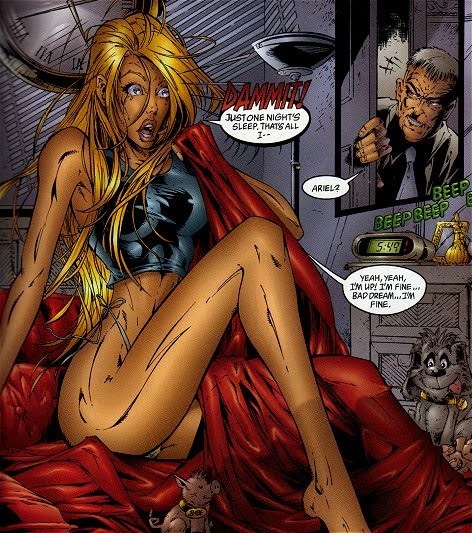 |
| The work of a professional artist that in no way manipulates both boobs, an ass curve, a panty shot, and a supermodel leg into one panel |
This, of course, is foolishness, because criticism and critique is well-known to be fair use. He promptly got torn to shreds by popehat, techdirt, and themarysue among others, and later retracted the defamation suit, and apologized publicly on his facebook page to an audience of reassuring fans and sycophants.
the DMCA and lawsuit I assume was meant to be a statement of dominance, a threat to promote the chilling effect over criticism of his artwork, backfired in a major way. Now he'll be lucky if this isn't a career killer, even with a plea to his broken marriage and the death of his late mother as his excuse.
I suppose poor mental health is a case for sympathy but I have very little patience for his sob stories if he considers parody, commentary as "harassment" as if the big bad tumblr blog actually had an impact on the viability of his livelihood, self-security or salary.
I suppose poor mental health is a case for sympathy but I have very little patience for his sob stories if he considers parody, commentary as "harassment" as if the big bad tumblr blog actually had an impact on the viability of his livelihood, self-security or salary.
Queen's case isn't unique, however. In a recent episode of Jim Sterling's Jimquisition, Sterling details the behavior of "suicidal indie devs" that make small studio video game development look as bad as AAA establishments by picking fights when sub-quality product gets deservingly torn a new emergency exit.
Perhaps the key word here is "suicidal" in terms of their behavior. Sterling phrases it,
"While it may feel cathartic to have a video torn down from the public eye because it made fun of your shitty game, the long-term effects so far has only ever proven to be bad for the dev: who only gets negative publicity that does not translate into game sales."And of course, sales and the numbers are of paramount worth to the publishers that might carry games, comics, books, and other media. If you've made a fool of yourself on social media or even with a useless lawsuit, fewer publishers are going to want to risk dealing with not only your nonsense, but also the public knowledge that you're a hack and that you couldn't deal that someone said your stuff wasn't perfect.
Large studios, whole comic labels, and corporations of any sufficient size largely don't care if somebody doesn't like their products. They engineer products such that even if some people protest, their media is formulated to be as trivial, samey, and "safe" as possible. There's even books about how to do this. No matter the backlash at Disney for, say, the laziness of re-using their designs for main characters in a major animated film, the amount of money and esteem they lose is minimal, droplets of consumer tears in a desert of blistering corporate indifference.
But individual artists, small studios? In their quest to swagger and never suffer impactful criticism, to enjoy product safety just like the big guys, they just prove how much they are the little guy by waving the legal notices and the social media threats at critics, who don't take any of their garbage. And neither do their followers, which see, tweet, and reproduce the work like crazy.
This leads to perhaps a reverse chilling effect, where attempts to stifle or censor criticism and speech instead increase and popularize said speech. The two narratives compliment, actually: both improving one another. On one hand, the published or released product isn't very good. On the other hand, the person who made it likes to bully anybody who doesn't like their stuff. A bully makes unmentionable bad stuff. Bad people making bad things is something that people like to talk about. I'm talking about those people right now, even!
 |
| I'm talking about people talking about those people, who don't want those people to talk about them. |
And what's better; this trend of hubristic gentlemen with willing lawsuit-waving spirits and weak flesh is in no way new. Harlan Ellison, a science fiction writer who penned hundreds of short stories has also filed plenty of lawsuits from the '80s to around the early 2000s for supposed stealing or infringement or criticism of his work-- famously trying to shake down James Cameron and Terminator for supposed IP theft to no success. Later, in 2006, he went after Fantographics supposedly for publishing defamatory, anecdotes about him in their publication. There was a settlement, links to the case were taken down off Fantographics' website, but there was no payout; presumably the threat to him was not real enough for him to win a case.
Perhaps the reaction is even more panicked in our current media environment, because when critics take apart media it's not just a bad score on Rotten Tomatoes or an unflattering column in an entertainment mag. It's Let's Plays, interactive blogs, and video reviews that have full advantage of fair use to not only in review blow the content to smithereens, but also to break it down visually and sequentially with detail, to connect it to other greater trends, to do it in an environment where some critics can even become web stars themselves.
It's harder to shrug off "Eh, it's just one unprofessional snob" when that critic has thousands of followers on youtube or twitter. But when you go to try and silence that person so they can't broadcast to that audience anymore, that audience notices and suddenly you've been caught being a total jerk by hundreds of people. Attempts to prevent something from reaching the audience, alert the audience to that someone is trying to stop something from reaching it. The public is impossible to control at least in this way.
Beyond corruption, and beyond greed, it's lack of control and insecurity that drives these self-destructive creators to break themselves on the rocky shore of social media and public review. They may want to look tough, perhaps, but they probably don't feel so tough. They know they're not so tough, and fear a world where the first google result for their work is a mocking beatdown.
Unfortunately, with childish media responses, they make that reality true by their own hands: a bloodbath not just of their work, but for their ugly control-freak personalities.
Perhaps the reaction is even more panicked in our current media environment, because when critics take apart media it's not just a bad score on Rotten Tomatoes or an unflattering column in an entertainment mag. It's Let's Plays, interactive blogs, and video reviews that have full advantage of fair use to not only in review blow the content to smithereens, but also to break it down visually and sequentially with detail, to connect it to other greater trends, to do it in an environment where some critics can even become web stars themselves.
 |
| Some have even started their own businesses. |
Beyond corruption, and beyond greed, it's lack of control and insecurity that drives these self-destructive creators to break themselves on the rocky shore of social media and public review. They may want to look tough, perhaps, but they probably don't feel so tough. They know they're not so tough, and fear a world where the first google result for their work is a mocking beatdown.
Unfortunately, with childish media responses, they make that reality true by their own hands: a bloodbath not just of their work, but for their ugly control-freak personalities.