Showing posts with label internet comments. Show all posts

Feeding the Trolls: Social Media in Politics

Posted by Alexandra Salazar on Friday, October 11, 2013

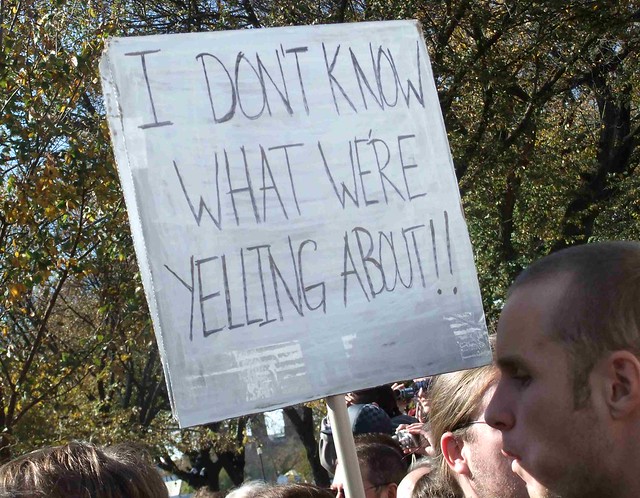
Anyone who has ever had access to comment boxes, discussion threads, or any kind of unmoderated forum knows what trolls are. Well, maybe not everybody; the definition's been a bit muddied, but the original one is still good: someone who posts inflammatory or obviously attention-seeking opinions with the intention to incite an angered response or backlash.

A troll draws near! (But ignore it, it's probably a cry for attention)

The point being, the poster is not sincere. A troll is not a troll when they sincerely spit a bad or stupid idea and then try to defend it with 'just trolling,' that's just an ordinary bigot that also happens to be a coward.

However, in a landscape of political conflict, trolling seems to have a new stage: a paid stage. In India, there are individuals recruited to endorse a political party on social networks by attacking opposing party speech:
Arjun, who joined Twitter in 2010, started actively tweeting in June 2011 - primarily sharing his views music, sports, recent events, life and politics. His tryst with political trolls started the day he tweeted some information about the Gujarat CM Narendra Modi.
As Arjun started taking these trolls head on, he realized that his follower count was increasing dramatically. It didn't take long for some prominent political leaders to start 'following' him and engaging in chats with him. After his tweets got featured on a television debate, he was approached by the 'recruiters'. 
Their proposition was very simple. He was asked to write blogs promoting the party's agenda and policies. In return, he was promised up to Rs 10,000 or more per blog depending on the word limit. While journalists are often termed as 'paid media', concept of 'paid trolls' is still considered to be an urban myth.
It's no secret that in the USA, social media was a huge point of force in the 2012 presidential election, and yet its power is still dismissed with the fact that some people tweet pictures of their lunch. How long until the trolls are actually fed - and clothed - by real money for their efforts?
More aboutFeeding the Trolls: Social Media in Politics

Link: Can Social Media Save NASA?

Posted by Alexandra Salazar on Monday, October 7, 2013

Selena Larson of ReadWrite made an interesting conclusion: For NASA's 55th anniversary on October 1, it got a government shutdown and completely frozen funding. 97% of its employees, many scientists and other highly educated professionals, have been furloughed. However, while Congress only has a 10 percent approval rating, NASA is much-beloved.

Third-party efforts seek to use social media to restore at least partial funding to its operations, and science-loving folks everywhere are down to do just that. This is a case where twitter gets political in a frustrating situation where it seems like ordinary people have no power to change things.

As if millions lots of voices employees suddenly cried out in terror, and were suddenly silenced

Especially young people. As an example, Larson reports on NASA's own social media strategies to build buzz. Invoking the name of a major celebrity popular with young girls had a dramatic effect:
One big push for NASA is to find ways to reach more young people to encourage an interest in science and technology. Twitter has been a successful platform for engaging a younger audience, including megastar Justin Bieber and his almost 45 million followers. After tweeting an invitation to help the young musician take his act into space, NASA saw a huge uptick in its follower count, including many female fans whom it might have struggled to reach through traditional means.
We all have something to say about Mr. Beiber, but his name and his media carry weight and they mean something enormous to people: people that NASA needs now more than ever. There are connections between the media that we love, media that we may consider less important than the likes of our space program, and how active we are in perceiving issues. 
More aboutLink: Can Social Media Save NASA?

Analysis of a Parthian Shot.

Posted by Alexandra Salazar on Saturday, October 5, 2013

Is this now going to be a short series on feedback media? OK, I guess this is now a short series on feedback media.

A few days ago, I discussed how feedback can create a dialog between consumers and content producers. Then, I discussed how feedback can create a dialog between consumers and other consumers. Now, I guess I am going to talk a little bit about manifestations of feedback-based dialog in real life, and how it's part of a bigger issue.

If anybody here's brushed up on historical or period warfare, the Parthian Shot was a tactic used by ancient Parthian (which was a middle-eastern empire) mounted archers. They would retreat, or pretend to retreat, and fire arrows behind them; chasing troops would advance into the cover fire.

Old school drive ride-by.

The shot I want to look at today didn't happen in the first century AD, but on September 25, 2013, and it happened on the internet. Tech blogger Jessica Roy left the online tech journal BetaBeat, and left behind a list of all the things she's not going to miss.

The list boils down to, ultimately, 'sexism.' But there are some interesting elements to her strongly-worded displeasure. Some of the highlights worth mentioning:
8. The notion that being the slightest bit critical makes you a “hater,” and the idea that providing any kind of coverage that isn’t a big sloppy BJ shows a lack of “journalistic integrity.”
Here, Roy comments on the reception of criticism and the nature of feedback. Note the similarity to Carolyn Petit's predicament when she dared to give a popular video game a 9/10, and tell me that there isn't a pattern. What is it about this feedback culture that frames professional critics as a threat when they do their jobs and are critical of media?
Also, all those snotty mansplainers and people who called me a “cunt” for talking about women in tech, and anyone who tries to derail honest conversation about these issues by finding minor typos or formatting errors that they can use to discredit my entire perspective so that they don’t have to reflect on their own participation in a culture that so clearly devalues women’s beliefs.
We can probably assume safely that the audience giving Roy and Petit feedback is similar: men who object to the voice of a woman (and all that nasty 'perspective') in their domain of choice. But Roy isn't just talking about her experience, she is also speaking about the media she's tried to produce: it's a stone-cold fact that only a quarter of IT jobs are held by women, and that many graduates with tech degrees find they cannot be hired to apply them. The comment contributors Roy curses for dismissing her points and coverage also are dismissing reality, not merely a matter of opinion or a difference in personal worldview. And they do it on a micro-basis: in a comment box, over a misplaced comma or a typo.

It's ludicrous to think that a copy error means that a proven fact of the tech industry and the perspective of somebody actually there, are invalid. But I guess that's why Roy left.

This is a dialog where the comment box intersects the real world, and real world decisions to stay or leave employment. It's easy to dismiss the significance of a mob of anonymous strangers, but as micro-aggressions build up over time, the feedback culture has the power to override artistic integrity, stop other consumers in their tracks, and even deny reality.
More aboutAnalysis of a Parthian Shot.

Comment Box Beatdown: A New and Violent Dialogue.

Posted by Alexandra Salazar on Sunday, September 29, 2013

I'm going to assume that almost everyone reading this knows what a comment box is. There's one below every post here. Bastions of free speech: moderated comments allow anyone who cares even a vague amount to express their opinion to everybody who passes by. In the least calm and rational manner possible, in some cases.

It sort of looks like this. (Photo: Flickr user sokup)

The crux of every social media site includes comments, along with media sharing. Even sites dedicated to user-generated (rather than shared) content communities, like Deviantart, Fictonpress, Ravelry, and Etsy include comments as a focal part of their platform: allowing anyone to create written, art, or craft work and then receive feedback on it from a general audience.

As mentioned yesterday, audience feedback is a dialogue that has taken on a new form and sense of power from the presence of the internet. Fan approval or outrage can sway the sales and distribution of media, and either laud or revile the personalities that talk about it.

I'm talking about critics. The push-button-to-hate culture doesn't make it easy for them to handle what essentially is considered the general public's beloved baby.

Why did you downvote my baby?! (Gif: Spirited Away)

The fifth installment of the popular video game franchise Grand Theft Auto was recently released, after about five years of development. Fans were elated to get right back into the popular wide-open no-consequences sandbox game and start stealing cars and running over grandmas.

Then Gamespot, popular gaming community hub, rated the game a lowly 9/10.

The resulting backlash of not getting a perfect score was so great, Gamespot made a response video calling out the chaos.

Pictured: Gamespot's audience gets told.

As the host of Feedbackula eloquently states,
"There were so many comments this week saying that political discourse doesn't belong in game reviews, or that it's 'just a game' and 'we should just shut up and deal with it.' Really though, honestly, what kind of attitude is that? How does that make the gaming community look? If we ever want to see games being broadly accepted as an art form, or as anything but a slightly quirky pass-time, we have to include politics. we have to ask questions about gender, about the portrayal of characters, and about the limits of satire. Because satire isn't satire if it doesn't challenge the thing it copies; that is repetition."
As most readers can probably infer, the non-perfect score was awarded due to the limited roles of women portrayed in the game: as unsatisfied wives, hookers, straw-feminists made to mock actual strives towards gender equality, and other less-than-empowering roles. The messenger of this dissatisfaction was Carolyn Petit, a game journalist who also is a trans woman. This went over as well as one could expect in a largely unprogressive, male-dominated gamer culture.

Not well. (Creative Commons)

The theme of an insecure male-dominant fanbase (despite over 40 percent of gamers identifying as women) being uncomfortable with women being an authority on the games they are possessive of is pervasive and certainly nothing new. Raging fans created a petition to try and get Petit fired from Gamespot (since removed). Anita Sarkeesian, feminist media critic and host of Feminist Frequency received death threats for daring to make a video series commenting on sexism in video games, and one maladjusted individual even created a whole flash game about battering her.

Trying to fire Petit, and trying to silence Sarkeesian, are two unorganized, organic efforts to try and subdue a discourse that some consumers find threatening to their worldview. The studios that make these games, have nothing to do with this dialogue; consumers are yelling at other consumers, through the easy-reward-low-investment-low-accountability interface of a comment box.

Youtube is trying to clean up the veritable hive of scum and villainy that rests below every flash player on their site. Their approach involves algorithms that sort comments, burying the least valuable ones to humanity below ones that at least don't wear underwear on their heads. Theoretically, this is supposed to limit visibility of frustrating comments, so nobody reacts to them and their presence is not rewarded, discouraging their presence. Whether this is censorship is debatable. By trying to encourage people to link their google pages accounts to YouTube, Google has tried to reduce the shield of anonymity on offensive comment trolls, but with limited success.

The determination and free time of angry internet trolls are limitless, however, and one can only imagine how long it will take for someone to invent a web gadget that restores the comments to how they were before. Whether this is in defense of free and unrestricted speech, or over-entitlement to the right to call people fags behind an anonymous mask, only time and downvotes will tell.
More aboutComment Box Beatdown: A New and Violent Dialogue.